
Where should you start with AI in SAP SuccessFactors?
Discover four practical HR AI use cases in SAP SuccessFactors and how to prioritise them for real business value.
Douglas unified HR across 20 countries with SAP SuccessFactors, working with Effective People. Projects at that scale teach you one thing quickly: the technology is rarely the hard part.
That decision is now harder. AI is moving beyond content generation and into the execution of HR processes, from spotting employee data errors to supporting career development. Are you facing a long list of new capabilities with no clear sequence? We hear that often, and so does the frustration behind it: vendor announcements that blur what is production-ready.
Choosing well matters. A misprioritised pilot can waste a 12-month budget cycle. And a delay in showing value can weaken your HR tech case in the next planning round.
I'm Gustavo Bohn, and in this guide we look at four areas where AI can make a practical difference. Then we offer a simple way to decide which one comes first.
Which four areas offer the most promising AI opportunities?
The strongest opportunities usually sit where HR teams spend considerable time resolving exceptions, gathering information or repeating the same tasks. Each of the four areas below fits that pattern.
HR operations: identifying problems before they affect payroll
Traditionally, specialists investigate each error, find its root cause and decide on the fix. It's slow, repetitive work.
The SAP SuccessFactors Employee Data Integration Agent shows how AI can help. It analyses replication errors, recommends corrective actions and, where appropriate and subject to human approval, applies corrections. The human approval step is the safeguard that protects your payroll data.
The value goes beyond saved troubleshooting time. Resolving issues earlier helps protect business continuity and gives HR and payroll teams greater confidence in their data.
Performance and talent: helping managers act earlier
Performance management often relies on scheduled conversations and periodic reviews. By the time a challenge becomes visible, the chance to step in may have passed.
AI can help managers spot risks to goal achievement, monitorprogress and consider next steps throughout the cycle. SAP SuccessFactors capabilities for goal progress and career development show how existing HR context can feed more timely guidance to managers and employees.
Learning and skills: connecting development to workforce needs
Assigning learning content is easy. Knowing which activities will close your actual skills gaps is far harder.
AI can identify skills gaps, recommend relevant learning and help you manage compliance training more proactively. For HR leaders, that links learning more closely to workforce planning, employee development and business priorities.
There's a catch, though. The value depends on the quality of your skills, role and employee data. If you lack a reliable view of workforce capabilities, you may need to strengthen those foundations first.
HR administration: reducing the effort behind everyday operations
HR teams and system administrators spend considerable time on permission issues, policy questions, workflows and system troubleshooting. Sound familiar?
AI can increasingly gather the relevant information, identify likely causes and recommend or support the right action. This is an important shift: AI becomes part of how HR processes are executed, not just another interface for finding information.
If your team handles high volumes of repetitive administrative work, this may reduce operational friction and free specialist capacity for more complex activities. It is also often a lower-risk starting point than talent use cases, because the work is repeatable and easier to review.
Is your organisation ready for AI, or does it depend on the use case?
Data quality is fundamental to successful AI adoption. But the foundations required to support AI depend on the process in which it will operate.
Career and skills recommendations are a good example. The prospect of using AI to identify skills gaps, suggest career paths and recommend development opportunities is attractive. However, if job architecture, skills information, employee profiles and career data are incomplete or inconsistent, the recommendations may offer limited value.
The same principle applies to operational processes. An organisation exploring AI-supported Employee Central transactions or payroll-related activities needs reliable configurations, integrations and underlying HR processes.
Permissions, workflows, governance and knowledge sources also influence how effectively and safely AI can operate.
Poor data quality, inconsistent processes and unstable integrations will not disappear when AI is introduced. In many cases, AI will simply expose these problems faster.
An organisation may therefore be well prepared for one AI use case while requiring significant foundational work for another.
Assessing readiness in relation to a specific business objective helps you determine where AI can deliver value today and where investment in your HR foundations should come first.
For a closer look at these foundations, read our article Is your HR data ready for AI? Five questions to ask before you invest.
How do you prioritise AI use cases in SAP SuccessFactors?
With so many capabilities on offer, it's tempting to start with what the technology can do. A better starting point is your own HR organisation: where do you see operational challenges, recurring exceptions or chances to improve decisions?
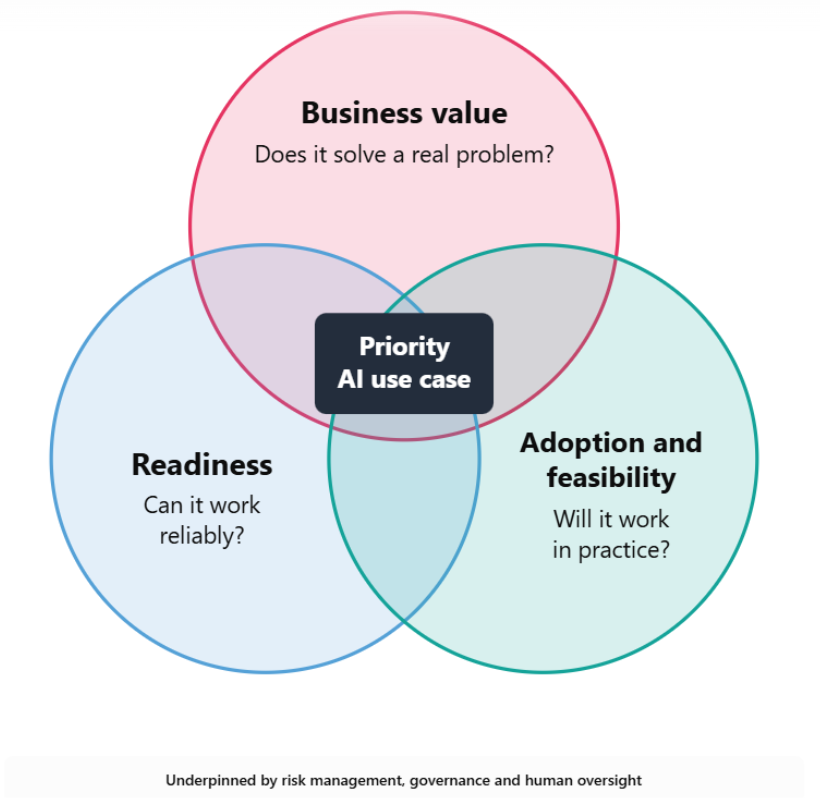
Business value: does it solve a real problem?
Look for processes with high transaction volumes, significant manual effort or recurring exceptions, as well as activities where faster or better-informed decisions could make a meaningful difference.
Consider:
How frequently does the problem occur?
What is the impact on HR, employees, managers or business operations?
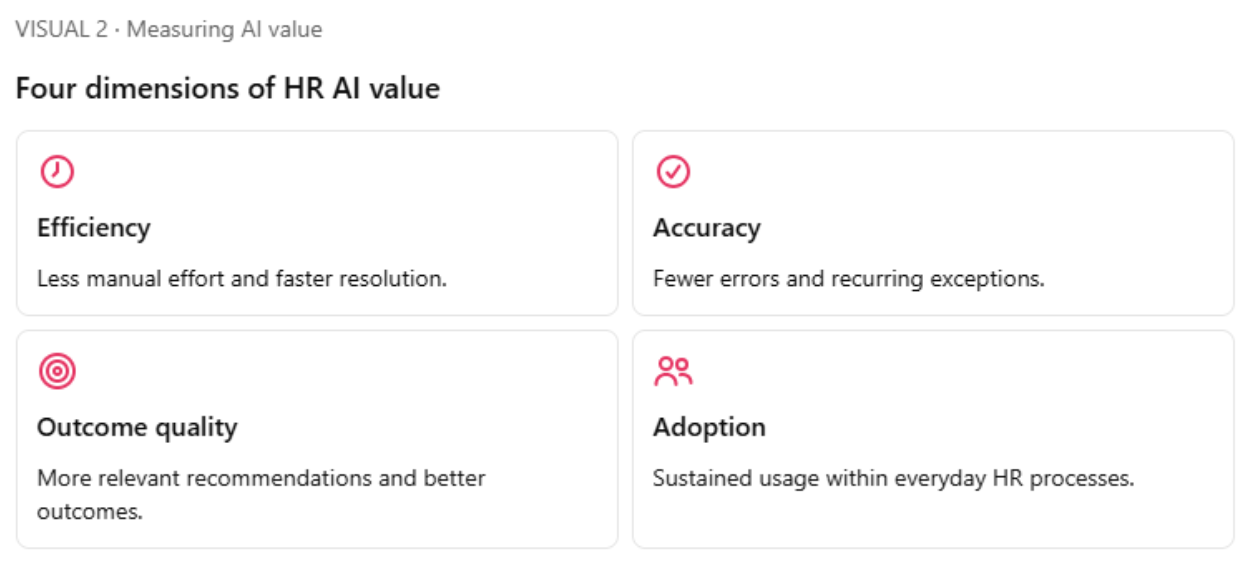
Could AI improve efficiency, accuracy or the quality of decisions?
How would you measure the improvement?
Organisational readiness: can it work reliably?
Assess whether the underlying HR process, data and technology can support the intended outcome.
Consider:
Is the relevant data accurate, complete and accessible?
Are the underlying HR processes consistent and reliable?
Are configurations and integrations stable?
Are permissions and knowledge sources appropriate for the intended use case?
Where these foundations are insufficient, addressing them may be the most valuable first step towards AI adoption.
Adoption and feasibility: will it work in practice?
Even a technically sound AI use case can struggle to deliver value if it sits outside the way people actually work.
Consider:
Does the capability fit into an existing HR process or workflow?
Will employees, managers or HR specialists find it useful?
What changes to responsibilities or ways of working will be required?
Can the organisation realistically implement and sustain the change?
Risk, governance and human oversight should underpin every assessment. Organisations need to establish where human review remains necessary, who is accountable for outcomes and how AI-supported processes will be monitored.
Together, these considerations help you identify opportunities that are commercially meaningful, technically realistic and likely to become part of everyday HR operations.
Organisational readiness
Assess whether the foundations are in place to support the intended outcome.
Is the relevant data accurate, complete and accessible?
Are the underlying HR processes consistent and reliable?
Are system configurations and integrations stable?
Are permissions and knowledge sources appropriate for the intended use case?
Risk and governance
Consider the implications of introducing AI into the process.
What decisions or actions would AI support?
Where should human review or approval remain?
Who is accountable for the outcome?
How will the organisation monitor accuracy, exceptions and unintended consequences?
Together, these criteria can help you distinguish opportunities that are ready to pursue from those that require further preparation.
What does a practical framework for your first HR AI use case look like?
Start by mapping each candidate against business value and organisational readiness. It gives you a clear picture to prioritise from.
A high-value opportunity with weak data or process maturity may still deserve investment.
Equally, a capability that's easy to switch on may offer little value if it solves a problem you don't have.
Your first initiative should let you show a meaningful improvement, learn from it and build a credible base for wider adoption. That's how you present a roadmap to your executive team with confidence, as a leader who modernised HR responsibly.
Aramex offers a useful reference for what disciplined delivery looks like.
Think beyond AI enablement: how should the HR process change?
One of the most important questions organisations face is how their HR operating model should evolve as AI becomes part of everyday processes.
Consider an AI capability that identifies employee data errors and recommends corrective actions. Enabling the capability is only one part of the change.
The organisation also needs to determine who reviews the recommendations, which corrections can be approved, how exceptions are escalated and how the process is monitored.
Without these decisions, AI may introduce additional review steps rather than reduce the workload it was intended to address.
The same principle applies across talent management, learning, employee support and HR administration.
Successful AI adoption therefore requires organisations to consider technology, process design, governance and human responsibilities together.
How do you know whether your AI investment is delivering value?
Measuring the impact of AI requires a broader perspective than simply calculating time saved.
An AI-supported process may be faster, but its real value could lie in fewer errors, more consistent outcomes, reduced operational friction or stronger user adoption.
Depending on the use case, relevant measures could include:
Time spent resolving employee data or integration errors.
The volume of manual interventions required.
Time spent by HR administrators investigating routine issues.
The speed at which managers identify and respond to performance challenges.
The relevance of learning recommendations to identified skills needs.
For example, the value of an AI capability supporting employee data integration could be measured through fewer recurring errors, reduced troubleshooting effort and fewer support tickets.
For an AI capability supporting employee development, the relevance of recommendations and employee adoption may be more meaningful indicators than time savings alone.
Establish a baseline before introducing AI and agree what a successful outcome would look like. This provides a foundation for assessing results, refining the process and deciding whether to extend AI into other areas of the organisation.
The objective is to demonstrate a sustainable improvement in how HR operates.
Build an AI roadmap around your HR priorities
As AI capabilities continue to evolve within SAP SuccessFactors, organisations will have an increasing number of opportunities to improve how HR operates.
The challenge will be deciding which opportunities deserve investment, what needs to be addressed first and how existing processes should evolve.
At Effective People, we combine HR process knowledge with SAP SuccessFactors expertise. We help you assess readiness, identify high-value AI opportunities and shape a practical roadmap for adoption.
Whether you're exploring a first use case or expanding existing initiatives, our AI Discovery Workshops help you evaluate the opportunities in your HR landscape and agree the right next steps.



About the author
Gustavo Bohn is a Senior Consultant and Solution Architect.
Gustavo is professionally certified and an expert in global implementations and multiple SuccessFactors modules.
Gustavo is Effective People's SME in Employee Central and is in charge of the associated team of 20+ employees, showcasing Gustavo's excellence in terms of both his SAP-related insight as well as his leadership abilities.


Ready to identify where AI could deliver the most value for your HR organisation?
Discuss your first HR AI use case with us.